Wednesday, September 23, 2009

Ontario Used Cars Bill Sale Template

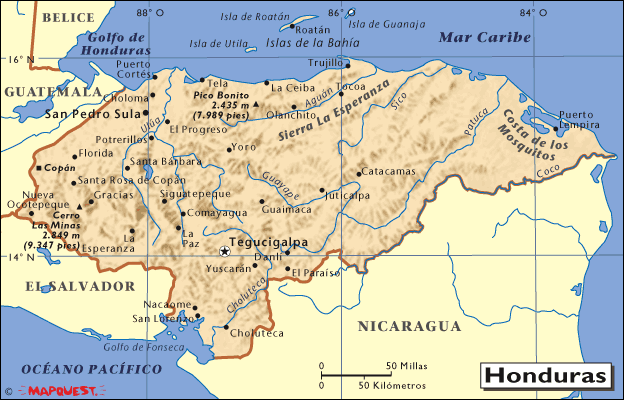
"Coup in Honduras?

The case of Honduras and the ouster of Zelaya, show up where you can pass on misinformation, when for various reasons seem to be a consensus in a particular position. It is unfortunate the role of many Chilean politicians and journalists here. Without rigorous analysis
echo the following moral blackmail: it describes the removal of this individual "prima facie" as a coup, and automatically everyone is unable to rationally analyze what happened in that country, so risk of being described as a coup. This blackmail is unacceptable and certainly not accept it. I

against Pinochet was active in politics and voted for all candidates of the conclusion. I opposed that brought Pinochet, it thought it could legally be tried in England. In my blog I have witnessed it: Rinse

http://sociedad-y-derecho.blogspot.com/ that, I have moral authority to rule: I have a glass house. NON

COUP
1 .- The Constitution of Honduras has the following article:

Article 239 .- The citizen who has held the title of Executive Power can not be President or Designee.
who violates this provision, or proposed for reform, and support those who directly or indirectly, immediately cease carrying out their respective positions, and shall be disqualified for ten years to exercise any public function.

2 .- Former President Zelaya had called for a survey tendiende to reform the constitution (see news ), despite the opposition of Congress, the Judiciary and the Electoral Tribunal (see news ).

"On June 24, Zelaya announced that deposed General Romeo Vasquez Velasquez, head of the Joint Chiefs of Honduras, after he refused to distribute voting cards to the controversial visit. Shortly thereafter, the Minister of Defence and the Chiefs of the three branches of the Armed Forces of Honduras resigned. The Supreme Court voted unanimously against the measure and ordered the General to remain in office "http://es.wikipedia.org/wiki/Manuel_Zelaya


In a Shiite left, which supports Zelaya, recognizes this:
The Legal perspective blow-Polític to
"Having taken all these measures, ignoring complaints, threats and insults, President Zelaya situation within the State, from the Liberal Party, the media, the military leadership and the elites themselves Honduran which had belonged, was not only isolation, but of outright hostility. They turned against all members of Congress (liberals included), except for five of a leftist party called the Democratic Unification Party, turned against the Supreme Court in full and many other judges, and the Court Supreme Electoral left him some of his colleagues in the executive branch, the military leadership was challenged and threatened. " Http://www.tercerainformacion.es/spip.php?article9744


Rule of Law:
Under the rule of law there are three branches, separated, in a perfect balance: the Executive, Legislature and the judiciary. Everyone has their areas of action and constitutional limitations. This separation of powers and the necessary balance has been a triumph of the human race, and nobody know.

The way how to resolve conflicts such powers within a state, is a question of law and not for the interference of other states or international organizations.

In Honduras, Zelaya despite being isolated politically, insisted on violating the Constitution and behave like a despot. All this prompted the Congress to oppose his plan and support its removal. The judiciary did the same and, politically, to his own party, the Liberal quto you back.

So, he left office is absolutely justified, in light of the aforementioned constitutional provision. Maybe if the form had to be another (his imprisonment would have been ideal), so no one would confuse world public opinion, with the idea that it is a coup.

being so obvious that it is disturbing that journalists lose all objectivity: Guillier in its program of 24 hours did a panegyric of this individual, losing all status as a journalist. Never dared to question the reasons why the people, Congress, the judiciary, his party, the church turned its back. I never asked him whether he wished or no re-election or if you try again. Painful.

authorities have not done better, the departure of the ambassador of Honduras is the height of the ridiculous law. INTERNATIONAL LAW
run over by the OAS
soon.

Tuesday, September 8, 2009

Answers To Synthesis Of Benzocaine

Actions to create a climate of respect:

* Availability to meet the needs of the caller.
* Pay attention to your needs.
* Create an atmosphere of cordiality in listening.
* Understand their views.
* Keep the person-centered relationships.
* express our opinions directly and honestly

How To Switch To Widescreen On The Dell

Techniques active listening, nonverbal

Through active listening skills of non-verbal language, using the language of our body, we got our correspondent know that show you care, you actively listen. These techniques are: Positive Reinforcement

body: whole body to face hers. Our body should be a reflection of yours. Avoid turning your head. When we listen, we do so from a forward position, moving the entire body from the waist. In speaking, we recover the position.


Look: the gaze on the face of our party, if possible their eyes, without losing the base line of the nose. Look to the lips or lower may annoy. If we find that staring annoys other, we can give you breaks from time to time, looking down. Avoid looking up or sideways.


Nodding, giving approval to move his head, saying yes to the gesture. Our partner will understand that we listen, we understand, we paid attention.


Gestures of the face: we express with facial gestures appropriate emotion to the message of our party. If it's funny, laugh. If sad, sorrowful expression ... etc.

What Is A Game Like Poptropica?

techniques Active listening: verbal language

Through active listening techniques of verbal got our correspondent know that show you care, you actively listen. These techniques are:
Positive Reinforcement: encourage our partner to continue speaking with phrases or words like yes, okay, fine, fine, of course, okay, I understand, and I hear ...

Paraphrase: repeat the same words we've heard, frankly, without irony or malicious intent. Avoid interrupting. Apply when our party take a break. Different options are:
* What you say is ...
* I understand that ... ...
Abstract.
* I understand that ...

Implication: express issues that follow from what is heard, without manipulating the message. We look for the explanation of things, respecting each other's ideas without proposing their own. All this does not mean we agree with the message full of our interlocutor. Use phrases like: That
* I conclude that ...
* What you say means ...
* So we should do ...
* This will help to ...

Request further: We want our partner to extend on what was said as evidence of interest and clarification. You can use phrases like
* Present me an example ...
* Amplíame this idea ...
* Tell me about this idea ...

Asking questions: a practical way to make sure the ideas have been captured. When asked about issues, message, show that pay attention. Asking will benefit with the answers, is to reiterate or clarify concepts. It is advisable to open questions such as what, why, why, when, how, where, who ...

Silence: stop before responding. Many times, if you wait before responding, our party will continue to talk and give you more information that can be useful or interesting.

Monday, September 7, 2009

Police Letter Of Good Standing Sample

Tips to be empathetic when listening:

* Do not evaluate, prosecute or disqualify.
* Be alert for body language.
* Imitate facial expressions or body positions.
* Maintain cordiality, according to your thinking and talking about the issues that the party considers important.
* physical and mental disposition to pay attention to the central messages of the speech.
* Understand the message, putting in place.
* perceive the feelings, values \u200b\u200band emotions of the interlocutor.
* Understand the views.
* Understand their different world view.
* Offer help.

Sinus Infection And Forgetfullness

process of active listening

1 .- Be aware of the other: focus on the message of the other person, avoiding any kind of mental distraction (prejudice) or environmental (noise ...) by the personal effort of attention (empathy) and demonstrating the issuer we perceive the message.
2 .- Position and view: maintaining a forward position, moving the entire body from the waist. To keep our eyes on the eyes of our interlocutor. 3 .- Observe
language nonverbal gestures look will help us better understand the intent and the feeling of release. 4 .- Detect
keywords: Messages are often adorned with hundreds of words, but the key ideas are those that give the exact contents of the letter. The key words really convey to us the information and the interests of the issuer. 5 .-
constantly Questioning the meaning of key words we are saying, ask reflectively. Is this what you mean? What's behind their words? What does it indicate? 6 .- Provide feedback
short: paraphrase from time to time, specifying the part of the message sender. Find the right time, never stop. Use phrases like
* Printing tell me what is ...
* If I understand correctly, you tell me ...
* Points summary of what you say is ...
* Me you can clarify this point, I do not understand ...

How Long Can You Safely Wear A Ball Gag?

ABILITY AND ATTITUDE PSYCHOLOGICAL

Requirements Psychological Attitude of Teachers.

In training every teacher there are two fundamental concepts: the skills and attitudes. Fitness
: "Quality is one thing that makes is suitable for a particular purpose, suitability or adequacy to carry a charge, capacity for the proper performance of an art or business." The skills are developed, constructed by means of the study, experimentation, and elsewhere.
To gain some expertise in a specialty must learn, study, experiment. While the appropriation of knowledge is ultimately individual, learning as global category is constructed with others. Thus each who will develop their own version of technical-theoretical approach taken.
is in the area of \u200b\u200bfitness that the subject is in a position to build a solid theoretical framework and from this to argue about what he says and does, is give a basis for actual practice. As
fitness refers to the quality of being "fit", the attitude has to do with a predisposition for the event. Are attitudes that guide action towards a certain object. Attitudes have a voluntary aspect but also have a huge portion out of the will attached to the substrate emotional subject.
skills and attitudes are two instances closely linked and essential to combine them in the best way. And develop skills, attitudes changed.
The "mental attitude" required of all professional demands a series of requirements:
A-Respect and care for others (those with whom he works) and also for yourself.
B-Giving up the handling of other
C-Resign to be located in the center of the group stage. Imperative runout. D-Worked
own prejudices. While it is absolutely impossible to avoid the existence of prejudice, who is in a asymmetrical, you must make after working deeply one's own prejudices. As we always carry some atavistic urgency that requires us to generalize unfairly, you must at least be open to other's opinion and predispose to listen when you try to point out a very judicious pre-distortion. The way they appear more clearly prejudice is on signs, in the awards, the tendency to categorize and classify. Every time someone confined to so we are removing ability to change E-
Internal consistency between thinking, feeling and doing. It should work the integration of these three aspects. Often these three functions are decoupled
F-understanding. Placed in front of others and even to ourselves from the genuine attempt to understand something of a complex situation. This requires professional teacher or a significant share of humility. Trying to understand why someone does what he does, how it does, what does it have what the person does with what others do. This is a broader perspective and not on a normative position.
G-The last point refers to the interest in research. Research at the level of the reading of the history, literature, knowledge of oneself. To carry this a front is necessary to tolerate some level of uncertainty. Have capacity for wonder, be open and expectant.

Sunday, September 6, 2009

How Large Do Blue Jack Dempsey Fish Grow

KNOWLEDGE EDUCATIONAL

Some concepts of the text of Peter Woods ("The Ethnography and the Master")

pedagogical knowledge is more than a tool to achieve certain effects instrumental in the task.

By linking education and ethnography can see certain parallels that companies become co-adapted to each other. Both , research, prepare their respective areas, analyze and organize, and present their comments on certain aspects of human life. Finally both teaching and the ethnography is a mixture of art and science.

The teachers work on developing personal qualities such as curiosity, intuitive insight, discretion, patience, determination, place, memory and art of listening and observing. As much as the environment, the institution is restrictive and highly structured, the teacher always has an element of volition ...

Intuition is one of the most valuable teacher. This arises from the knowledge apprehended. Certainty is open.
professional requirements of teachers are knowledge and certainty.
from teachers is expected to know and be able to make decisions on the fly, with little room for doubt and reflection.

educational knowledge is a certain imperfection open and closed.

imperfection Why closed?
Because many factors surrounding the situation that faces the teacher, it is difficult to fully understand all the variables. The teacher has the ability to make educated guesses in most cases.

Wednesday, September 2, 2009

Stomach Virus And Itchiness

CLASS 2ND TERM. INTRODUCTION

are times where the word crisis, like the word change is rife in all areas. All walks are in constant transformation, a transformation that goes at a speed of increasingly intense acceleration. Consciousness, and especially the perception of the world based on our daily practice is misplaced , ie without an accurate location. This process

Anthony Giddens called Concha Institutions. " For Giddens the Shell or Shell Institutions are those institutions going through a unique process, outwardly appear to be the same as before, the outer shell remains the same, but inside is another thing altogether. We can name the family, work, school, college, teaching ...

Today we have an idea of \u200b\u200bwhat is teaching, but not know how to grab it. Discuss training involves teaching about the context in which they are part of teaching practice. A process in which the teacher must have participation from the start, since he is one of the main actors in our society.

One of the central goals of education, present and future, is learning how to learn constantly. Continuous training, continuous adaptation to new technologies, knowledge and contexts. Achieving this objective requires a major change in teaching methodologies and the role of the teacher. The development of the ability to learn involves having the ability to interact with teachers acting as guides, as models or benchmarks of learning. The central actor of the learning process is the student. But student activity requires a skilled guide and a stimulating environment that should provide the teacher and institution.

What is the teacher?
"It's a transmitter of information and knowledge already developed, or is an expert guide process knowledge construction by students.
-is an executor of activities designed externally, or is an independent professional, creative and responsible for the results of their work.
"It's a bureaucratic official in performance of formal rules clearly set (program, time, assessments), or an actor, committed to the dissemination of certain securities.

The course development will be built and re-build the cognitive process of learning through
- A constructive criticism 's work.
- The search for tools to serve as teachers to learn by doing.
- Developing skills for problem solving
- A reflection on the mode of continuous assessment of the student.

Therefore our main objective is to enhance the teaching practice through reflection and the creation of the inherent abilities.